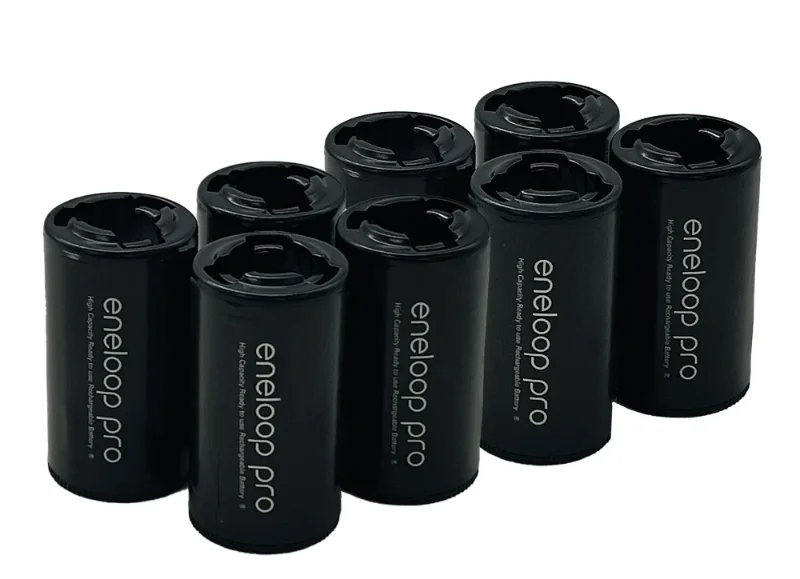
One AA in a bigger shell
Panasonic makes no C or D size eneloop for the US, and its US support page says so directly. In their place it offers plastic adapters, each holding one AA cell and bringing it out to the size of a C or D cell so it sits in the bigger slot.
Inside the shell the AA stays an AA. Panasonic’s pack text says the cell keeps its AA performance characteristics, so the capacity in a D slot is the capacity of the AA you put in it. With a standard eneloop AA from a current US pack that is 2,000 mAh minimum, and with eneloop pro AA it is 2,500. A C shell and a D shell differ only in their outer size, so the same AA gives the same charge in either one.
The shells weigh little on their own. The pack descriptions list the C adapter at 0.35 ounce and the D at 0.77 ounce without a cell, and the AA inside adds 27 grams by the global spec table, a little under an ounce. The black pro shells come in at 0.33 ounce in C size and the same 0.77 in D.
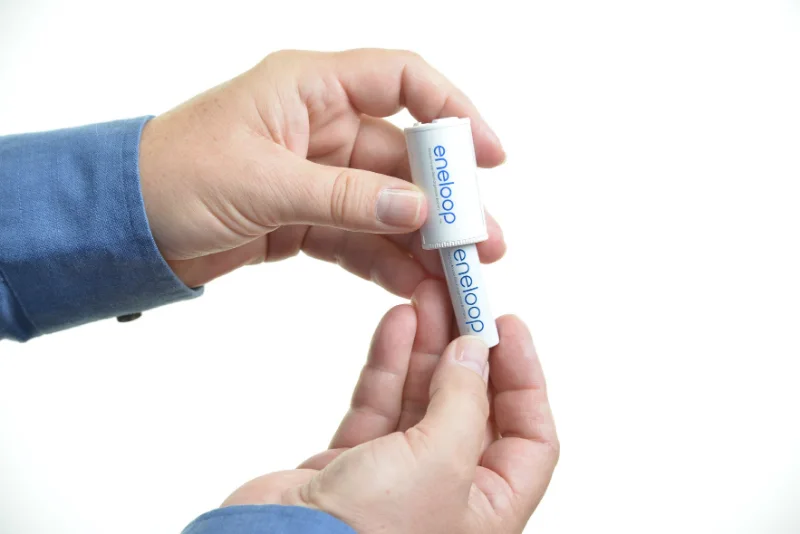
What changes in the device
Run time changes first. A device built for D cells was designed around a cell much larger than an AA, and with adapters it runs on an AA’s charge. Expect it back on the charger sooner than it needed fresh D cells. The draw of the device decides how much sooner, and Panasonic publishes no figure for it.
Your choice of AA still moves the result. By the minimums on current US packs, a pro AA puts a quarter more charge into each shell than a standard AA does, 2,500 mAh against 2,000. In a lantern that takes four D cells, that quarter applies to every cell in the set. A flashlight built for two C cells runs on two AA in shells, with the same arithmetic per cell.
Voltage stays where it was. Panasonic’s spec table lists eneloop at 1.2 volts per cell, and the shell is plastic around the AA, so the device sees the same cell in a wider jacket.
-
from $9.99


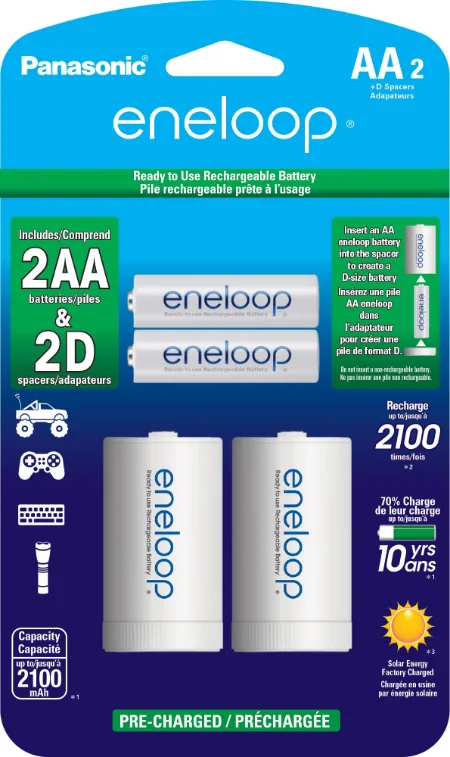
Why Panasonic calls them temporary
The eneloop FAQ describes the C and D adapters as intended for temporary use only. It gives no reason. A likely one: an adapter gives a C or D device an AA’s charge, and for a device that runs for long stretches every day, that means more trips to the charger than the device was built around.
That makes the adapters a good fit for some jobs and a poor one for others.
- A good fit: a radio for a power cut, a toy that would otherwise sit dead until the next trip to the store, a flashlight for a weekend at the cabin. Afterward the AA come back out, go on the charger as a set and wait in a case for the next time.
- A poor fit: a fan or lantern that runs every evening on C or D cells. Each refill costs a trip to the charger, and an AA’s charge in a D slot runs out sooner.
- Not at all: anything with a watertight, sealed battery compartment, such as a waterproof flashlight. Panasonic warns of a bursting or leakage risk with eneloop inside such devices, and a shell around the cell does not change that.
Seen this way, the adapters are a bridge for the devices you rarely touch. They spare you a drawer of C and D cells kept for one radio and one lantern, and one set of AA covers both.
The cell comes out to charge
The eneloop FAQ is plain on this point: do not charge an AA while it sits inside the adapter. Every eneloop charger has slots for AA and AAA only, and a C or D shell does not fit them, so the routine runs in four steps.
- Open the adapter and take the AA out.
- Charge the AA on any eneloop charger, together with the other cells of its set.
- Let the charger finish. The CC55 manual, for one, says to leave cells in until the indicators go out completely.
- Put the AA back in its shell, and the shell back in the device.
Two more rules from the same FAQ belong next to the steps. Put only eneloop cells into the adapters, never alkaline ones. And fill a device with cells from one set, of the same line and the same age, because Panasonic wants cells of one capacity and one age working together. A lantern holding two standard AA and two pro AA in its shells breaks that rule even though every shell looks alike.
Panasonic sells a standard version of each shell and a black version under the pro name, and its pack text pairs each version with its own line: standard shells for eneloop AA, pro shells for eneloop pro AA. Keep them paired that way, and you can read the set from the color of the shell without opening it.
Four D slots mean four AA, which is exactly one load for a four-slot charger. On the CC17 that load takes about 7 hours for standard eneloop and 9 for pro, by Panasonic’s approximate times. The CC55 finishes the same four AA in about 3 hours, or 4 for pro, which matters when the lantern is needed tonight.
Do not charge an AA inside a C or D adapter, and do not put alkaline cells in one. Both rules come from Panasonic’s eneloop FAQ.
Which packs include adapters
Adapters come three ways: as empty shells, as shells sold with AA cells, and inside three of the CC17 power packs. The contents below are the ones printed on each pack.
| Pack | Adapters | Cells included | Notes |
|---|---|---|---|
| eneloop C Size Adapters | 4 or 8 C | none | standard or pro version |
| eneloop D Size Adapters | 4 or 8 D | none | standard or pro version |
| eneloop C and D Size Adapter Set | 4 C and 4 D | none | standard or pro version |
| eneloop C Size Adapters with AA | 2 C | 2 AA or 2 pro AA | shells match the cells |
| eneloop D Size Adapters with AA | 2 D | 2 AA or 2 pro AA | shells match the cells |
| eneloop Power Pack with CC17 (KJ17MCC82A) | 2 C and 2 D | 8 AA and 2 AAA | with CC17 charger and storage case |
| eneloop Power Pack with CC17 (K-KJ17MC124A) | 2 C and 2 D | 12 AA and 4 AAA | with CC17 charger and storage case |
| eneloop pro Power Pack with CC17 (K-KJ17KHS82A) | 2 C and 2 D, pro | 8 pro AA and 2 pro AAA | with CC17 charger and storage case |
Count the slots in your device before you choose. A lantern with four D slots needs four D shells and four AA. If the AA are already at home, a shells-only pack of four covers it. Two of each come with the D adapters with AA and the C adapters with AA, enough for a two-cell flashlight. The power packs with the CC17 carry two C and two D, and the C and D set gives four of each. In the pro power pack the shells are the pro version, matched to the pro cells in the same box.
Prices for the D shells, sold in packs of four and eight in the standard and the pro version, from our latest update:
| Option | Price | Part number |
|---|---|---|
| 4-pack | $12.45 | BQ-BS1E4SA |
| 8-pack | $19.99 | BQ-BS1E8SA |
| pro, 4-pack | $12.97 | BQ-BS1K4SA |
| pro, 8-pack | $15.37 | BQ-BS1K8SA |
-
eneloop C and D Size Adapter Set
K-KJBS1/2
from $15.13
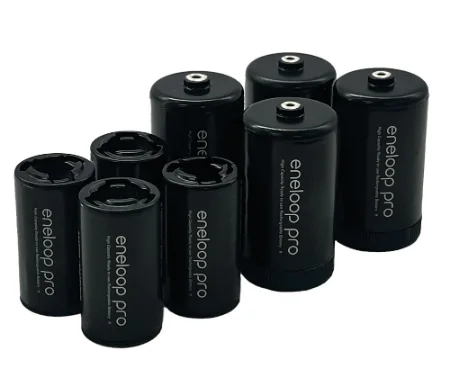
Which AA to put inside
Every AA in the eneloop lineup fits a shell of its own line, so the choice follows the device. For a radio or lantern that comes out a few times a year, standard eneloop suits the job: Panasonic’s estimate leaves 70% of its charge in place after ten years at 20 °C. For a device that drains hard in the hours it runs, pro AA put a quarter more charge in each shell. The trade is the one laid out in eneloop vs eneloop pro: up to 500 rated recharges for pro against 2,100 for standard, both under the 2011 test.
Keep the cells out of the device between uses. Panasonic’s US support page says to remove batteries from a device you won’t use for several months, so store the AA in a battery case next to the empty shells. If that kit travels, in a car or a storm bag, the FAQ’s carrying rule applies too: keep loose cells away from keys, coins and jewelry, and in a plastic case, not a metal tin.
Give the shells a set of their own. If the AA that fill them are the cells that run your remotes and controllers, an evening with the lantern leaves those devices empty, and the cells come back at different states of charge. A separate set of four, charged together and kept in its case beside the shells, stays a set, which is what the FAQ asks for. Before the months when outages come, put that set on the charger together, so every cell starts full and from the same point.
A lantern kept in a cold garage stays inside Panasonic’s range, since both lines are rated down to −20 °C (−4 °F on the US label). The AA batteries shelf lists every pack size of both lines.