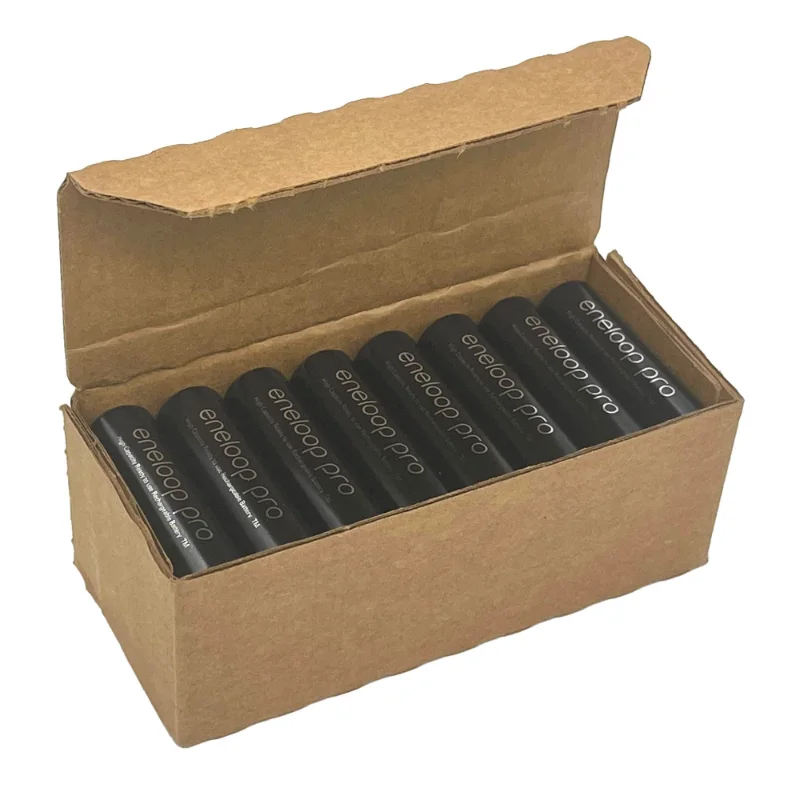
The two cells, figure by figure
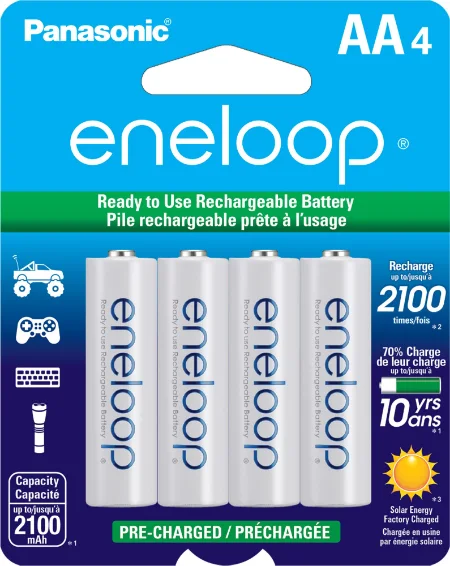
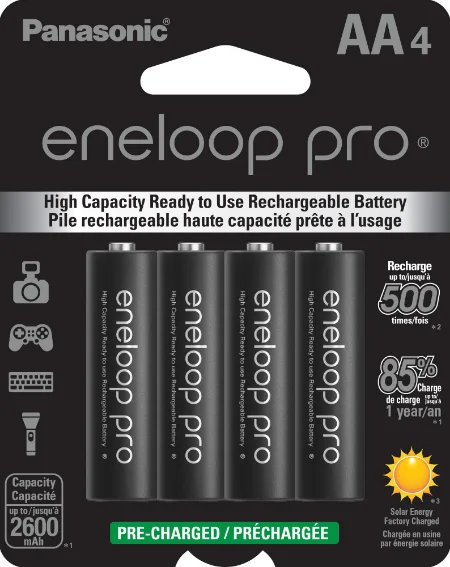
Turn over a current US pack of eneloop pro AA and the label reads 2,600 mAh typical and 2,500 mAh minimum. The standard eneloop AA beside it prints 2,100 and 2,000. On the AAA side the pairs are 980 and 930 for pro, 850 and 800 for standard. A few packs on the shelf still carry an older wording with lower pairs, and the capacity guide sorts those out pack by pack.
Set the minimums against each other and the arithmetic is simple. Dividing 2,500 by 2,000 gives the pro AA a quarter more charge than the standard AA, and 930 over 800 gives the pro AAA about 16% more. Panasonic rounds the gap differently by region: its global site says about 28% more for pro, while its US site says up to 20%, and the regional labels behind those two figures differ. For US packs, a quarter on AA and a sixth on AAA is the honest reading.
Recharges run the other way. Panasonic rates the standard eneloop at up to 2,100 recharges and the pro at up to 500, both under the 2011 edition of the IEC 61951-2 test. Under the 2017 edition, which the eneloop FAQ calls the stricter test, the figures drop to about 600 and 150. One page of the US site gives 700 for the standard cell, while the product page and the FAQ on that same site say 600. Read either edition and the standard cell keeps its lead of roughly four to one.
| eneloop | eneloop pro | |
|---|---|---|
| AA capacity on US packs (typical / minimum) | 2,100 / 2,000 mAh | 2,600 / 2,500 mAh |
| AAA capacity on US packs (typical / minimum) | 850 / 800 mAh | 980 / 930 mAh |
| Rated recharges, IEC 61951-2:2011 | up to 2,100 | up to 500 |
| Rated recharges, IEC 61951-2:2017 | about 600 | about 150 |
| Charge kept in storage (Panasonic estimate at 20 °C) | 70% after 10 years | 85% after 1 year |
| Operating range | −20 to 50 °C (−4 to 122 °F) | −20 to 50 °C (−4 to 122 °F) |
| AA weight | 27 g | 30 g |
| Four AA on the CC17 charger | about 7 hours | about 9 hours |
Charge kept on the shelf
How far ahead Panasonic will put a number on stored charge is where the two lines part. The standard eneloop carries a ten-year figure: 70% of its charge left after ten years, an estimate made at 20 °C and counted from the minimum capacity. The pro carries a one-year figure, 85% after a year under the same conditions. Both leave the factory charged, with solar energy by Panasonic’s account, so a fresh pack of either line works out of the box.
Those two claims cover different spans, so they do not line up into a ranking. No ten-year figure exists for pro, and no one-year figure for standard. What they do tell you is narrower and still useful. For a set of cells headed into a drawer, a go-bag or a flashlight you pick up twice a year, the standard eneloop is the line with a published long-term figure. Take 70% of the 2,000 mAh minimum and an AA left alone for a decade still holds about 1,400 mAh by Panasonic’s estimate.
Where you keep the cells decides how close you get to either figure. The eneloop FAQ puts the ideal storage range at 10 to 25 °C, warns against anything above 35 °C, and rules out the fridge because of condensation. A summer car and an attic both fail that test. The storage and travel guide covers cases, carry-on rules and recycling.
Matching the cell to the device
Rated recharges are spent one charge at a time, so a device that empties its cells often spends them fastest. Take a game controller charged twice a week, about 104 charges a year. At 500 rated recharges a pro AA reaches its rating in under five years, while a standard AA would need twenty. The stricter 2017 figures shrink both spans without closing the gap: about a year and a half for pro against nearly six years for standard.
These are rated figures from a lab test, not a promise for any one controller. They still show which way the trade leans for each kind of device.
- Charged weekly or more often (game controllers, kids’ toys, a wireless mouse): standard eneloop. Four times the rated recharges outweighs a quarter more charge per cycle when the charger sees the cells every few days.
- Worked hard, charged now and then (a camera flash through a long shoot, a headlamp on a night hike, a handheld game on a flight): eneloop pro. The extra capacity counts most when stopping to swap cells is the problem. Panasonic’s own test puts flash recovery at 3.3 seconds for pro against 76 seconds for an alkaline cell, a figure measured under the maker’s conditions.
- Used rarely, stored long (a TV remote, an emergency flashlight, a wall clock): standard eneloop, the line with the ten-year storage figure.
- Cold garage or winter trail: either line. Both carry the same rating down to −20 °C, printed as −4 °F on US packs, so cold alone does not decide between them.
The gap is narrower on AAA. A pro AAA holds about a sixth more than a standard AAA by the US minimums, against a quarter more on AA, while the recharge ratio stays four to one. For headlamps, remotes and small toys that take AAA, that tips the balance further toward standard eneloop.
A flash on a busy wedding day is the clearest case for pro. Even at one shoot a week, about 52 charges a year, the cells take close to ten years to reach 500 under the 2011 rating. For that kind of use, capacity per charge is what you are buying, and the lower recharge count stays a distant number.
-
eneloop AA Rechargeable Batteries
BK-3MCCA standard
2,100 typ · 2,000 min mAh2,100 rated cycles$2.77per cell, best pack
from $14.90


One charger serves both
Every eneloop charger sold in the US takes both lines, so a move to pro needs no new hardware. A pro cell simply sits on the charger longer, because there is more to fill. Panasonic’s approximate times for four AA: the CC17 needs about 7 hours for standard and 9 for pro, the CC55 about 3 and 4, the CC75 7 and 9, and the USB-powered CC87 4.5 and 6. On the eight-slot CC63, a full load takes about 5 hours for standard AA and 6 for pro, by the figures on its US pack.
Panasonic calls those times approximate and notes that a warm or cold room and the condition of the cells move them. Charge overnight and the gap between 7 and 9 hours passes while you sleep. Between sessions on a shoot, a quick charger narrows it to an hour. The charging guide sets all six chargers side by side.
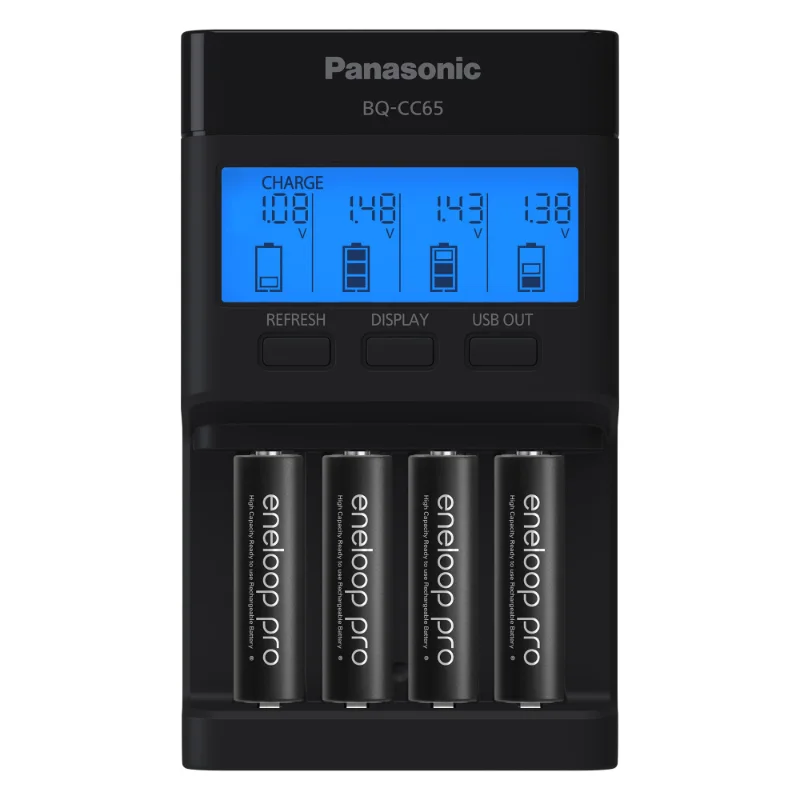
Kits pair a charger with one line or the other. The CC65 kit and the CC75 kit come with pro cells only, while the CC17 kit and the CC55 kit offer standard or pro AA and AAA. If your drawer already holds one line, buy the kit that matches it.
-
eneloop pro AA Rechargeable Batteries
BK-3HCCA pro
2,600 typ · 2,500 min mAh500 rated cycles$4.72per cell, best pack
from $22.24
Keep the two lines apart
The eneloop FAQ asks you not to mix batteries of different types, capacities or ages in one device, and to charge and use cells as a set. A standard AA and a pro AA in the same flashlight break that rule twice: different capacity, and usually a different age. In a device that runs its cells in a chain, the cell with less charge in it empties first, and the FAQ warns that running a cell past empty harms it.
The fix costs nothing. Keep each line in its own case, with the cells that were bought and charged together. Chargers, cases and adapters are shared, so the eneloop lineup splits only at the cell itself. The battery case comes in white and in a gray version sold under the pro name, which gives each line a box you can tell apart at a glance.
Panasonic also suggests recharging when a cell is about 70 to 75% used instead of running it flat. Within a set, that habit keeps the weakest cell from being pushed past empty while the others still have charge left.
What a cell costs, pack by pack
Larger packs bring the cost of each cell down, and the steps differ between the two lines. The table below gives the price per cell for every pack size of both lines, from our latest update.
| Cell | 4-pack | 6-pack | 8-pack | 10-pack | 12-pack | 16-pack | 24-pack |
|---|---|---|---|---|---|---|---|
| AA | $3.73 $14.90 pack | $2.77 $16.62 pack | $3.00 $23.99 pack | $3.20 $31.99 pack | $3.50 $41.99 pack | $2.82 $45.05 pack | $3.14 $75.33 pack |
| pro AA | $5.56 $22.24 pack | $5.70 $34.20 pack | $4.72 $37.73 pack | $4.76 $47.63 pack | $5.34 $64.09 pack | $5.49 $87.77 pack | $4.84 $116.22 pack |
| AAA | $3.25 $12.99 pack | $2.84 $17.06 pack | $2.00 $15.99 pack | $2.52 $25.17 pack | $1.91 $22.95 pack | $2.00 $31.98 pack | $1.98 $47.48 pack |
| pro AAA | $4.25 $16.99 pack | $4.49 $26.92 pack | $3.55 $28.36 pack | $3.55 $35.51 pack | $4.14 $49.72 pack | $3.93 $62.81 pack | $3.54 $84.85 pack |
Price per cell is half the comparison. Divide what a cell costs by its rated recharges and the standard eneloop spreads its price over four times as many charges. That second division matters most for a controller that lives on the charger, and least for a flash that comes out once a week. The comparison table puts every model, battery and charger alike, on one row each.