A fresh pack and its first charge
Panasonic ships eneloop cells pre-charged and says the charge comes from solar energy at its factory, under its Green Certificate system. A new card of eneloop AA can therefore go straight into a remote or a wireless mouse. How full it is depends on how long the pack waited on a shelf before it reached you.
Panasonic puts numbers on that wait. It estimates that a standard eneloop keeps 70% of its charge after 10 years at 20 °C (68 °F), and that an eneloop pro keeps 85% after one year. Both figures start from the minimum capacity, and both are Panasonic’s estimates rather than a reading of your pack.
A flash on a shoot or a trail camera that stays out for weeks deserves a full first charge, so the set starts the job topped up. In a TV remote, the cells can go in as they come.
From the first day, treat the cells in one pack as a set. Panasonic’s FAQ asks you not to mix cells of different capacity or age, and to charge and use the same cells together. Four cells bought, charged and loaded together stay a matched set.
Six eneloop chargers, side by side
Panasonic’s US support page says its eneloop chargers take any mix of AA and AAA and charge each cell on its own. So two AA and two AAA can share a charge, and a single cell gets a full charge without partners. The differences between models are speed, slot count, power source and what the charger shows you.
| Charger | Slots | Power in | 4 AA | 4 pro AA | Display | USB out | From |
|---|---|---|---|---|---|---|---|
| BQ-CC17 Overnight · with cells | 4 | AC wall plug | 7 h | 9 h | 4 LEDs | No | $16.31 |
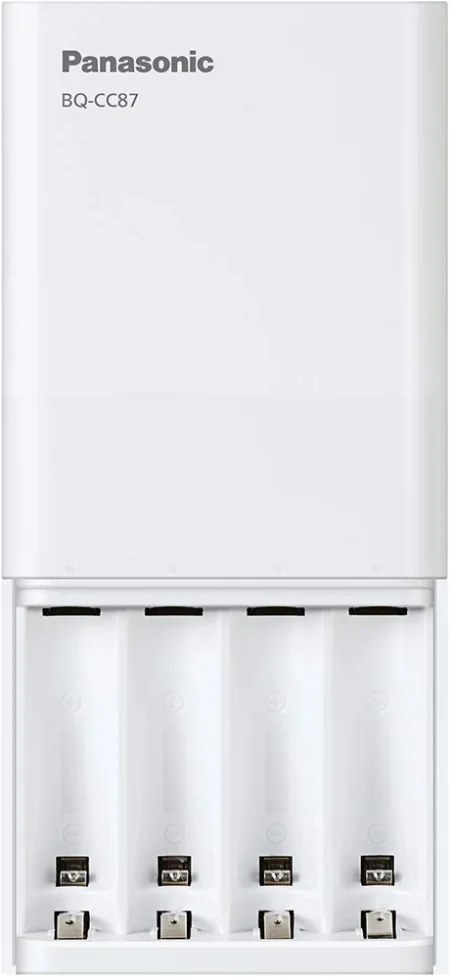
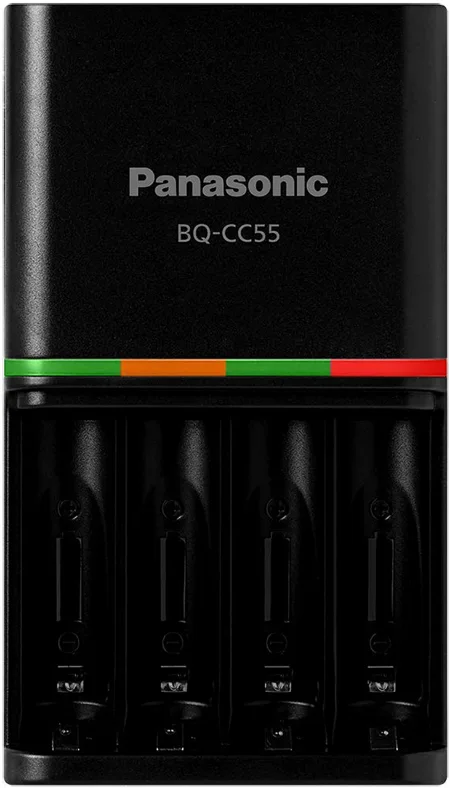
| BQ-CC55 Quick · with cells | 4 | AC wall plug | 3 h | 4 h | 4 three-color LEDs | No | $18.80 |
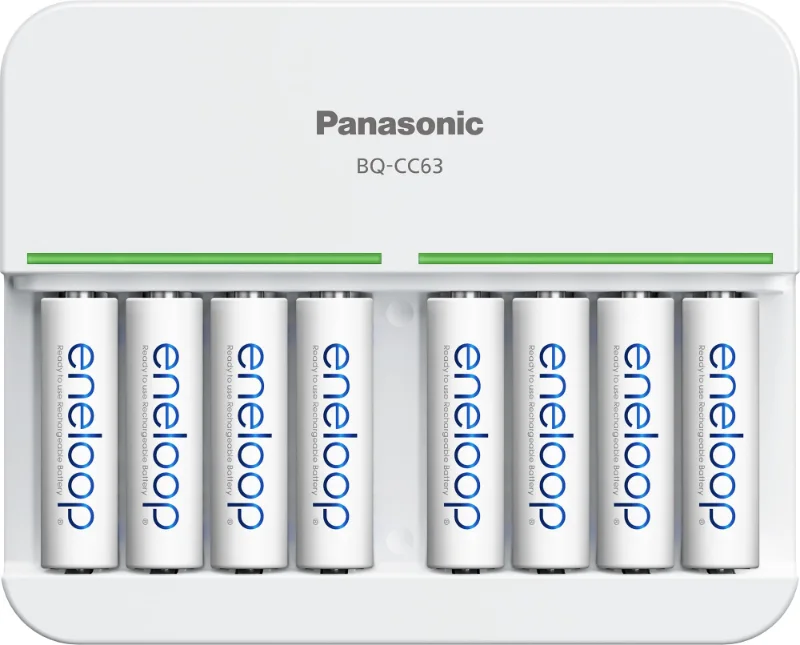
| BQ-CC63 8-slot · with cells | 8 | AC wall plug | 5 h | 6 h | 8 LEDs | No | $34.57 |
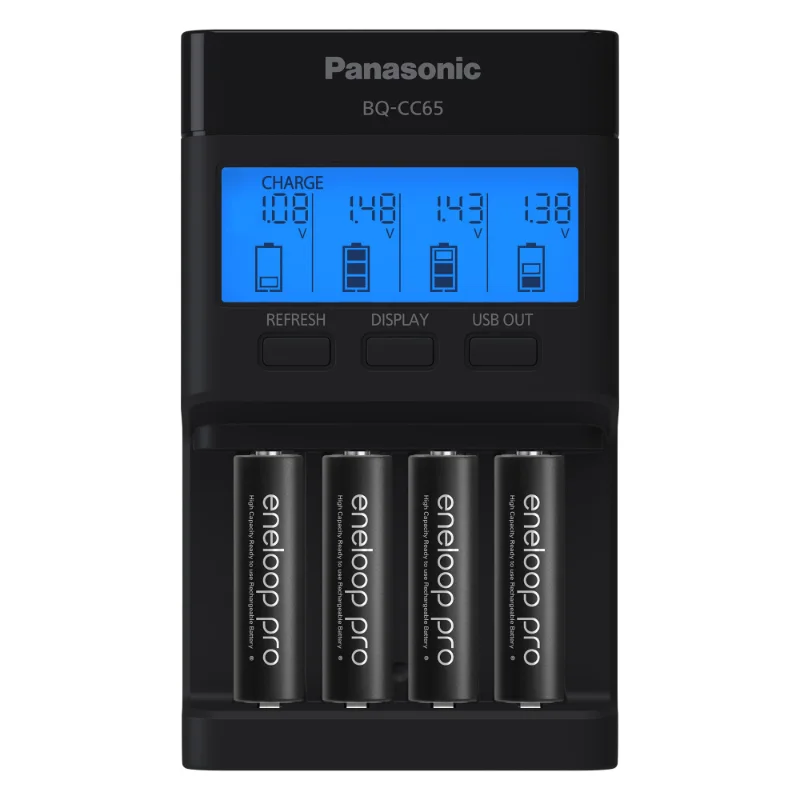
| BQ-CC65 Quick · with cells | 4 | AC wall plug | 3 h | 4 h | LCD panel | Yes | $52.99 |
| BQ-CC75 Overnight · with cells | 4 | AC wall plug | 7 h | 9 h | 4 LEDs | Yes | $16.83 |
| BQ-CC87 Portable · with cells | 4 | USB (5 V) | 4.5 h | 6 h | 4 LEDs | Yes | $21.05 |
Speed sorts four of the six. The CC17 and the CC75 are overnight chargers, at about 7 hours for four eneloop AA and about 9 for four eneloop pro. At the other end, the CC55 and the CC65 are quick chargers that finish four eneloop AA in about 3 hours. Then come two specialists. The CC63 holds eight cells, and the CC87 draws its power from a USB port instead of a wall socket.
Beyond speed, the extras matter in daily use. Where the CC55 signals with four LEDs in three colors, the CC65 has a 3-inch LCD. The CC65, the CC75 and the CC87 add a USB output for another device, and the CC87 can feed that port from four AA cells with no outlet nearby.
Each of the six also comes boxed with eneloop cells as a kit, four cells with most chargers and eight with the CC63. The CC17, CC55 and CC75 go further, into power packs with a mix of AA and AAA. If you own no cells yet, the charger kits shelf spares you matching the two yourself.
-
from $18.80


Charge times, and why two cells finish sooner
Three of the six chargers work faster on a half load. The CC55, the CC65 and the CC87 finish one or two cells in about half the time they need for three or four. Panasonic lists the CC17 at about 7 hours whether it holds one AA or four. The eight-slot CC63 is quicker with AAA: its specification page gives about 3 hours for up to eight AAA against about 5 for eight AA.
| Charger | eneloop AA | eneloop pro AA | Power |
|---|---|---|---|
| CC17 | About 7 h for 1 to 4 cells | About 9 h | Wall plug |
| CC55 | About 1.5 h for 1 or 2, 3 h for 3 or 4 | About 2 h for 1 or 2, 4 h for 3 or 4 | Wall plug |
| CC65 | About 1.5 h for 1 or 2, 3 h for 3 or 4 | About 2 h for 1 or 2, 4 h for 3 or 4 | Wall plug, USB output |
| CC75 | About 7 h | About 9 h | Wall plug, USB output |
| CC87 | About 2.25 h for 1 or 2, 4.5 h for 3 or 4 | About 3 h for 1 or 2, 6 h for 3 or 4 | USB input, USB output |
| CC63 | About 5 h for 1 to 8 cells | About 6 h (black pro version) | Wall plug |
An eneloop pro takes longer on every charger because it holds more charge, and the eneloop vs eneloop pro guide sets the capacity figures side by side. Panasonic marks each time as approximate and ties it to temperature and to the state of the cells. A cold cell, or one with years of cycles behind it, keeps its own schedule.
Leave the cells in until the lights finish. The CC55A instruction sheet says to charge until the indicators switch off completely, and it calls the remaining-charge display a rough estimate. Pull a set early and you leave with a partial charge.
The rules every eneloop charger shares
The instruction sheet for the CC55A lists its cautions in plain sentences, and most of them hold for any eneloop charger. Panasonic’s FAQ fills in the rest.
- Charge nickel metal hydride cells only. The CC55A sheet rules out non-rechargeable batteries, and Panasonic’s FAQ says its chargers carry a dry-battery detection feature that refuses them.
- Keep eneloop out of chargers built for Ni-Cd cells. Panasonic’s FAQ says not to charge them in one.
- Run the charger indoors, in a dry spot out of direct sun, between 0 and 35 °C (32 to 95 °F).
- Retire a charger with a damaged plug, and keep damaged cells out of the slots.
- Children use the charger only with an adult supervising, the CC55A sheet says.
- Take each AA out of its C or D shell before it charges. Panasonic’s FAQ says not to charge a cell inside an adapter, and the C and D adapter guide covers why the shells come off.
The charging range is narrower than the working range, and the gap matters in winter. Panasonic rates eneloop for use between −20 °C and 50 °C (−4 °F to 122 °F), so a set can run a headlamp on a frozen trail. The CC55A sheet sets 0 to 35 °C for charging. Cells that come in from a winter car or a cold garage go into the charger once they have warmed to room temperature, not straight from the door.
Warmth in the slots is part of the process. Panasonic’s FAQ says the surface of a cell can reach up to 55 °C (131 °F) while it charges, and that Panasonic chargers stop charging when they detect a risk.
An eneloop AA has the size and shape of an alkaline AA. Read the label before a cell goes into the charger: the CC55A instruction sheet rules out every non-rechargeable battery, alkaline and lithium AA included.
When to recharge a set
Panasonic’s FAQ suggests recharging once about 70 to 75% of the charge is used. It also warns against running cells down to nothing, which over-discharges them. In practice, swap the set when the device first shows a low-battery warning, and charge it then.
Every charge counts against a rated total, and the totals are large. Panasonic rates standard eneloop for up to 2,100 charges and eneloop pro for up to 500 under the IEC 61951-2 2011 test, and gives about 600 and 150 under the stricter 2017 version. The capacity and cycles guide explains what each test counts.
A second set makes that habit easy. While one set works in the camera or the game controller, the other sits charged in a case, and neither goes to empty. Two four-packs of the same type and age keep the matched-set rule intact.
Devices that rest for months need different handling. By Panasonic’s US support page, a device that will sit unused for several months should sit with its cells out. Where those cells go next, and at what temperature, is the subject of our guide to storing, flying with and recycling eneloop.
Which eneloop charger fits how you use the cells
An overnight charge on a kitchen counter is the CC17’s job. It plugs into the wall, holds four cells and takes about 7 hours. You also find it in kits with four cells and in power packs that add AAA cells and, in some versions, C and D adapters and a case. The CC75 keeps the same overnight pace and adds the USB output.
A photographer between sets wants cells back the same afternoon. The CC55 does four eneloop AA in about 3 hours, two in about half that, and the CC65 matches it with the LCD on top. For a flash and a recorder in the same bag, the CC63 takes eight cells at once. Its US kits pair it with eight AA, eight AAA, or four of each.
On the road, a wall socket is the one thing you cannot count on. The CC87 runs from a USB port and charges four eneloop AA in about 4.5 hours. It can also turn four charged AA into a USB power source for another device.
Your cells decide part of the choice. A drawer of eneloop pro charges about two hours slower on the overnight models than a drawer of standard cells. The eneloop lineup puts the four cell types and the six chargers on one page, so you can match a charger to the cells you already own. For slot counts, displays and USB ports in one grid, the comparison table lines all six up feature by feature.
-
from $21.05