Where eneloop cells keep best
Panasonic’s FAQ gives an ideal storage range of 10 to 25 °C (50 to 77 °F) and asks you to keep cells out of places above 35 °C (95 °F). Its US support page says the same in plainer words: room temperature, in a cool, dark, dry place. A shelf in a hall closet fits that description, and a glove box in July does not.
Cold is no shortcut either. Panasonic’s FAQ warns that a refrigerator brings a risk of condensation, and its US support page rules out both the refrigerator and the freezer. That condensation forms when cold cells meet warm room air.
For cells you have not opened, the factory packaging is the storage Panasonic’s FAQ names first. Charged cells lose their charge slowly on a shelf. Panasonic estimates that a standard eneloop keeps 70% after 10 years at 20 °C (68 °F). For an eneloop pro the estimate is 85% after one year, and both figures count from minimum capacity. A pro set that sat a year is worth a top-up before a shoot, and the charging guide lists how long each charger takes.
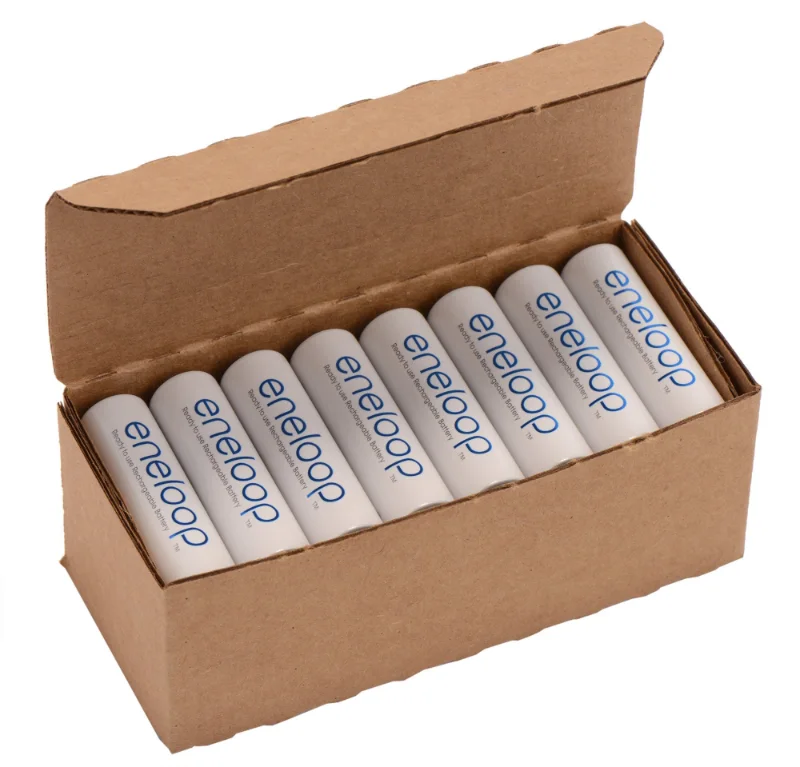
Store each set the way you use it. Panasonic’s FAQ asks you not to mix cells of different capacity or age, so the four cells from one pack share one case and come out together. Devices that rest for months should rest empty. Panasonic’s US support page asks you to take cells out of any device you will not use for several months. Think of the holiday light string, the toy that comes out once a year, or the spare remote in a drawer. Those storage rules hold for every size in the eneloop lineup, AA and AAA, standard and pro, so one drawer rule covers the whole household.
Keep metal away from the terminals
A loose AA in a pocket rides along with whatever else is there. Panasonic’s FAQ names keys, coins and jewelry as the things to keep away from eneloop cells, and it says not to carry them in a metal container. The Battery Network gives the household version of the same rule: do not store loose batteries together.
A plastic case answers both points. Panasonic’s FAQ suggests a case made of resin, and the eneloop battery case holds four AA or five AAA. It comes in packs of two and six, white for standard eneloop and gray for eneloop pro. Keep pro cells in the gray ones and you can tell the sets apart across a room.
-
eneloop Battery Storage Case
BQ-CASE
from $9.53


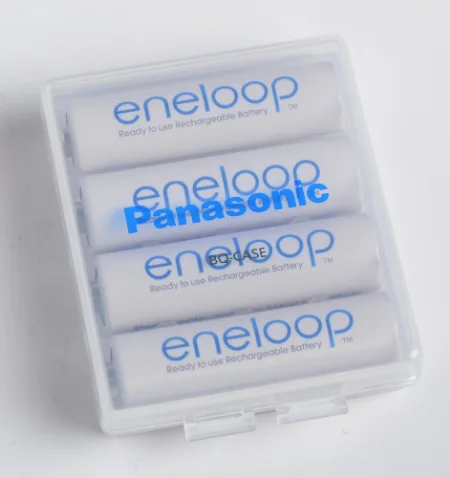
Spare cells do not belong in a tin box, a metal tool chest or a coat pocket full of change. Panasonic’s FAQ rules out metal containers and loose contact with keys and coins.
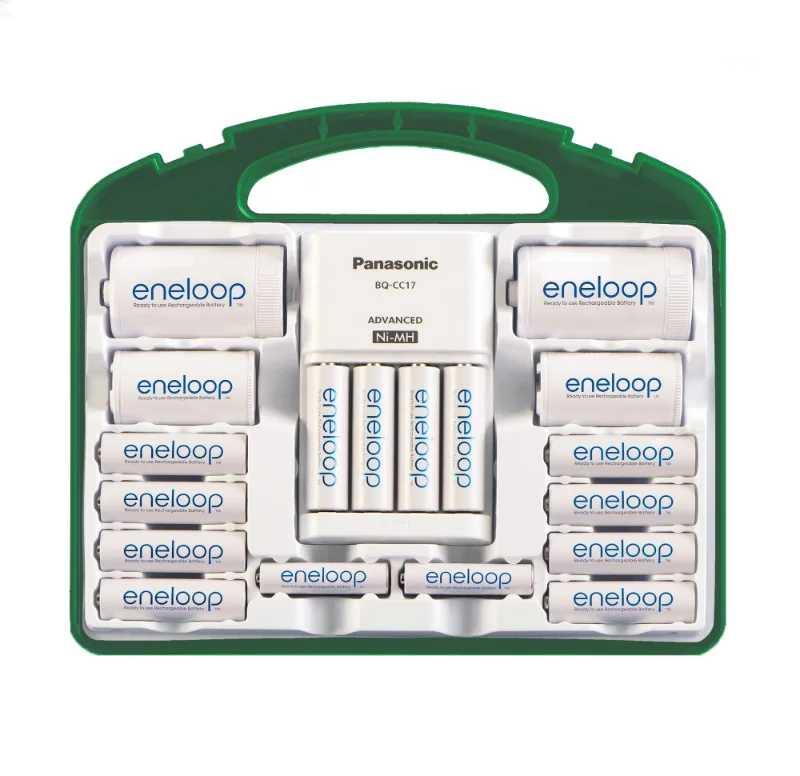
Some eneloop power packs ship with a case next to the charger and the AA and AAA cells. One of them adds C and D adapters as well. If you are starting from scratch, one of those covers the drawer and the bag at once.
-
from $44.45
Leaks, swelling and small hands
A leaking eneloop releases electrolyte that Panasonic’s FAQ describes as strongly alkaline. If it reaches your eyes, Panasonic says to rinse with plenty of water and see a doctor. Should anyone swallow a cell, the same FAQ says to get medical help at once.
Panasonic’s eneloop page adds the plain household rule: keep batteries out of reach of children. The charger counts too, and the instruction sheet for the CC55A says children should use it only with an adult supervising. A closed case on a high shelf keeps the cells out of reach.
Any cell that is swollen, hot or leaking leaves the normal routine. The Battery Network sends damaged batteries through separate instructions of their own, not into the ordinary drop-off box. Bag that cell on its own, keep it away from the rest of the set, and read those instructions before you take it anywhere.
One more rule concerns the device rather than the drawer. Panasonic’s eneloop page warns against putting the cells in devices with a sealed battery compartment, such as waterproof flashlights, where a cell can explode or leak. Read the manual of any sealed light before an eneloop goes in.
Flying with eneloop: carry-on and checked bags
eneloop cells are nickel metal hydride, and US air travel rules treat them as dry batteries rather than lithium ones. The FAA’s table for airline passengers lists dry rechargeable nickel metal hydride batteries as allowed in carry-on bags and in checked bags. Its PackSafe page sets no quantity limit for them. Panasonic’s US support page makes the same point from the other side, saying eneloop do not fall under the travel restrictions for lithium batteries.
The TSA agrees for the AA, AAA, C and D sizes. Its entry for dry batteries says yes to carry-on and yes to checked bags, and it names nickel metal hydride in the list of chemistries covered. The TSA also says the final decision rests with the officer at the checkpoint. On the FAA side, airline and international rules can be stricter than its table, so a trip on a foreign carrier calls for a look at that airline’s own page.
| Who says it | Carry-on bag | Checked bag | What it asks of you |
|---|---|---|---|
| FAA, passenger battery table | Yes | Yes | Protect the cells from damage and short circuit |
| FAA, PackSafe | No quantity limit | No quantity limit | A charging unit does not count as protection |
| TSA, dry batteries | Yes | Yes | The TSA officer makes the final call |
| Panasonic, US support | Not a lithium battery | Not a lithium battery | Keep cells away from keys, coins and metal cases |
Protection is the condition every row repeats. The FAA lists the ways that count: the original packaging, non-metallic tape over the terminals, a battery case, a separate pocket of a bag, or a snug plastic bag. For a camera bag of eneloop pro, a case per set covers it in one step.
The FAA says rechargeable batteries left in their charging unit are not considered protected. Move spare cells into a case or tape their terminals, even when the charger travels in the same bag.
The watt-hour limits that appear in airline battery rules, 100 Wh and 160 Wh, belong to lithium-ion spares and power banks in the FAA table, not to nickel metal hydride. A lithium power bank in the same carry-on follows its own row of that table.
Recycling eneloop in the US
The EPA puts it bluntly: do not put rechargeable batteries in the trash or in municipal recycling bins. eneloop belong to that group. The agency’s list of rechargeables names nickel metal hydride and notes that such cells can look like single-use AA and AAA. A battery’s type, the agency says, is identified by its marking and labeling, not by its shape, so read the wrapper on an eneloop rather than judging by its size.
Even a flat cell carries risk. According to The Battery Network, rechargeables hold residual charge even when they seem dead. The EPA says a used battery holds enough energy to injure or start a fire. Batteries thrown out with household trash or curbside recycling can ignite in garbage trucks and at sorting facilities, The Battery Network adds.
For drop-off, the EPA points to specialized battery recyclers, stores with battery take-back, and household hazardous waste collection. The Battery Network, the program formerly called Call2Recycle, accepts nickel metal hydride at participating locations and runs a locator on its website. It says most people live within 10 miles of one. Recalled batteries are the exception: participating locations turn them away, and The Battery Network sends you back to the maker.
- Put each cell in its own plastic bag. The Battery Network calls this the preferred method.
- Or tape the positive terminal. The EPA asks for non-conductive tape such as electrical tape, and The Battery Network accepts clear, electrical or duct tape but not masking tape or Scotch tape, which fall off.
- With opaque tape, leave the brand and the chemistry visible, as The Battery Network asks.
- Keep the bagged cells in a cool, dry place until drop-off day.
- Find a location with The Battery Network locator and confirm it takes rechargeable batteries.
A mixed drawer sorts quickly. Alkaline single-use cells need no tape unless they are marked lithium, according to The Battery Network. Only some locations accept single-use batteries, though, so check the locator before you bring them. Your eneloop and any other nickel metal hydride cells go bagged or taped every time. If some of them live in C or D adapters, take the AA out first. Panasonic’s US support page describes the adapters as plastic shells, and the cell inside is the battery to recycle.