Typical and minimum: two numbers for one cell
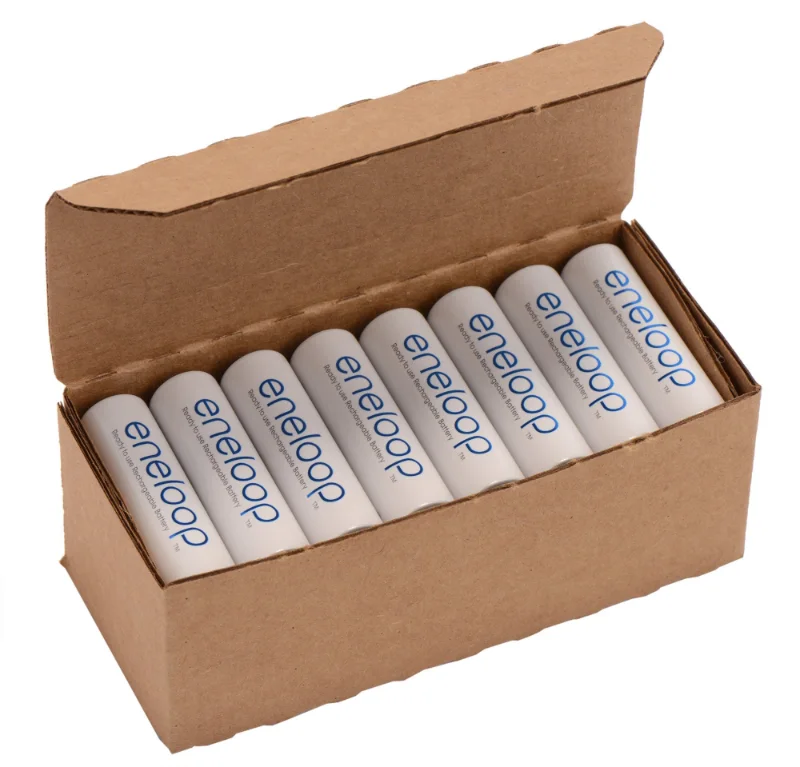
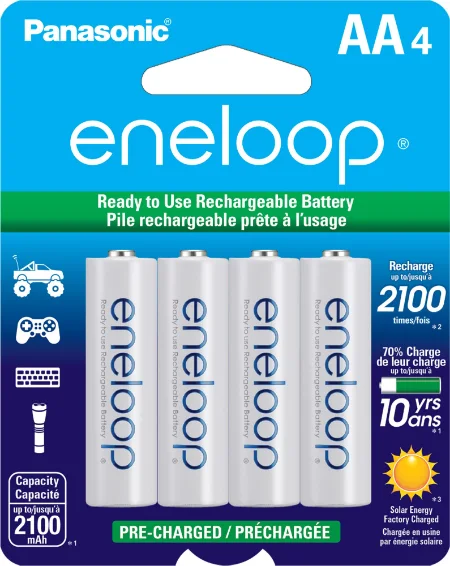
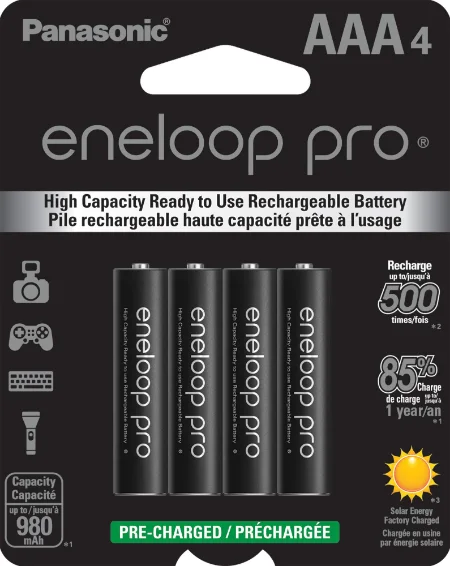
The back of a current US pack of eneloop AA carries two capacity figures: 2,100 mAh typical and 2,000 mAh minimum. The eneloop AAA pack prints 850 and 800. Pro packs carry the same pair of labels with larger numbers, 2,600 and 2,500 for AA and 980 and 930 for AAA. In each pair the minimum is the lower figure Panasonic rates the cell to, and the typical figure sits above it.
Plan with the minimum. Panasonic does the same: its storage estimates and its comparison between the two lines are both counted from minimum capacity, not typical. Compare two packs minimum against minimum and you read them the way the maker reads them, which keeps one pack’s typical figure from being set against another pack’s floor. On AAA the same reading gives the pro cell 930 against 800, about a sixth more.
A milliamp-hour figure tells you how much charge a cell holds, not how long a device runs on it. Run time depends on what the device draws, and no pack can print that for you. What capacity does give you is a ratio. A 2,500 mAh minimum against a 2,000 mAh minimum means a quarter more charge in the same device, under the same load, before the cells go back on the charger.
-
eneloop AA Rechargeable Batteries
BK-3MCCA standard
2,100 typ · 2,000 min mAh2,100 rated cycles$2.77per cell, best pack
from $14.90


Why two packs of the same cell print different numbers
The wording on eneloop packs has changed over time, and both versions still sit side by side. Panasonic’s US support page lists the standard AA at 2,000 typical and 1,900 minimum, while current single packs of the same AA print 2,100 and 2,000. Several CC17 and CC55 power packs, the C and D adapter packs and a few charger kits still carry the 2,000 and 1,900 wording. On AAA the same split reads 850 and 800 against 800 and 750.
Pro packs show it too. Most pro AAA packs print 980 and 930, while the 16-pack, the AAA in one CC55 kit and the US support page give 950 and 900. Pro AA adds a third pair: some power packs built around the CC55 and CC75 print 2,550 typical and 2,450 minimum. Panasonic’s US support page gives 2,600 and 2,550 for the same cell, and the global site lists a minimum of 2,500 or 2,450 with a note that the figure varies by region.
| Cell | Current US pack | Other wording on US packs | Panasonic US support page | Panasonic global site |
|---|---|---|---|---|
| eneloop AA | 2,100 / 2,000 | 2,000 / 1,900 | 2,000 / 1,900 | up to 2,000 / min. 1,900 |
| eneloop AAA | 850 / 800 | 800 / 750 | 800 / 750 | up to 800 / min. 750 |
| eneloop pro AA | 2,600 / 2,500 | 2,550 / 2,450 | 2,600 / 2,550 | min. 2,500 or 2,450 |
| eneloop pro AAA | 980 / 930 | 950 / 900 | 950 / 900 | min. 930 or 900 |
Neither the packs nor Panasonic’s pages say whether the cell inside changed or only the wording on the card. The pair that counts is the one on the pack in your hand. Every pack size of the standard AA and the pro AAA is listed on its model page, so you can match a pack at home to the size you plan to add.
One rule follows from the table. The eneloop FAQ rules out mixing cells of different capacities or ages in one device. Two packs that print different pairs fall on either side of that line, so treat each as its own set, and charge and use it as one. The same goes for a charger kit or a power pack: the cells inside carry the pair printed on that box, and on several of them it differs from the single packs.
-
eneloop pro AAA Rechargeable Batteries
BK-4HCCA pro
980 typ · 930 min mAh500 rated cycles$3.54per cell, best pack
from $16.99
2,100 cycles and the test behind the number
The 2,100 on a standard eneloop pack comes from the 2011 edition of IEC 61951-2, the test standard Panasonic cites in its footnotes. Those footnotes give a second figure under the 2017 edition, about 600 recharges for the standard cell. The eneloop FAQ calls the 2017 test stricter. One technology page on the US site prints 700 for the 2017 edition, whereas the US product page and the US FAQ both say 600.
- eneloop AA and AAA: up to 2,100 recharges under IEC 61951-2:2011, about 600 under IEC 61951-2:2017 (700 on one US page)
- eneloop pro AA and AAA: up to 500 under the 2011 edition, about 150 under the 2017 edition
Read the two pairs as two answers to two different exam papers. The cell is the same AA in both footnotes, and only the test changed. That is how a pack can print 2,100 while Panasonic’s own site gives 600 for the same cell, and neither figure is wrong.
Whichever edition you use, compare like with like. Set 2,100 against 500, or 600 against 150, and the standard cell comes out about four times ahead either way. Mixing the editions, 2,100 against 150 for instance, inflates the gap to fourteen times and tells you nothing about the cells.
A cycle count is a rating from a lab test, not a countdown running inside your cell. How you charge and store a set moves the real result, and the FAQ names two habits that help: recharge once roughly 70 to 75% of the charge is gone, and never run a cell completely flat. As a sense of scale, a set charged once a week reaches 600 charges in about eleven and a half years, and 150 charges in under three.
70% after ten years: what the storage figure says
A standard pack states that the cells hold 70% of their charge after ten years. The footnote narrows it: the figure is an estimate at room temperature, 20 °C, and it starts from the minimum capacity, not the typical one. For an AA that works out to 70% of 2,000 mAh, about 1,400 mAh after a decade in a drawer. An AAA on the same arithmetic keeps about 560 mAh of its 800.
Pro packs make a shorter claim, 85% after one year, under the same conditions. Standard packs carry no one-year figure and pro packs no ten-year one, so the two claims cannot be stacked into a ranking. They do show which line carries a long-storage figure at all, and the comparison of the two lines in eneloop vs eneloop pro leans on exactly that.
Temperature is where the estimate meets your house, and 20 °C is room temperature, not a garage in July. Panasonic’s FAQ gives 10 to 25 °C as the range to aim for and 35 °C as the line not to cross, and it keeps cells out of the fridge because of condensation. The US support page adds two habits: keep cells in a cool, dark, dry place, and take them out of a device that will sit unused for months. Cases and drawer habits are in the storage and travel guide.
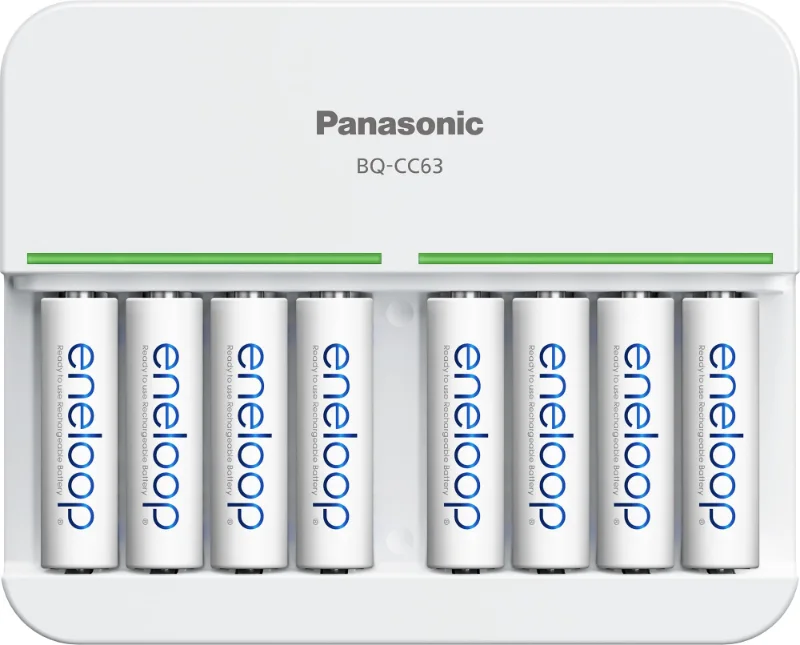
Factory charge belongs to the same story. Panasonic charges new cells before they ship, using solar energy by its own account. How much of that charge is left when a pack reaches you depends on how long it waited in between, and that wait is the one figure no label can print.
The rest of the label: volts, size, cold, origin
Panasonic’s spec table lists 1.2 volts for both sizes and both lines. The same table gives the dimensions. An eneloop AA is 50.5 mm long and 14.5 mm across and weighs 27 g, or 30 g in the pro version, and an AAA is 44.5 mm by 10.5 mm at 13 g. If a device has a tight compartment, those are the numbers to hold a ruler against. The same 14.5 mm is what a C or D adapter wraps in plastic to fill a bigger slot.
US packs print the cold rating as down to −4 °F. That is the −20 °C at the bottom of Panasonic’s range of −20 to 50 °C, and both lines share it. Packs also state that the cells are made in Japan.
Panasonic warns against putting eneloop cells into a device with a sealed, watertight battery compartment, such as some waterproof flashlights, because of a risk of bursting or leakage.
Reading a pack before you buy
- Find the minimum capacity. It is the number to compare, and the one Panasonic’s own percentages start from.
- Check the line: up to 2,100 rated recharges for standard eneloop, up to 500 for pro, by the 2011 test.
- Note the wording. If the pair differs from the cells already at home, keep the new pack as a separate set.
- Count the cells your device takes. A device with four AA slots needs a set of four, bought and charged together.
Every battery and charger in the eneloop lineup sits in the table below, each with the figures most of its current packs print.
| Figure | AA | pro AA | AAA | pro AAA |
|---|---|---|---|---|
| Capacity | 2,100 typ · 2,000 min mAh | 2,600 typ · 2,500 min mAh | 850 typ · 800 min mAh | 980 typ · 930 min mAh |
| Rated cycles | 2,100 rated cycles | 500 rated cycles | 2,100 rated cycles | 500 rated cycles |
| Charge kept in storage | 70% after 10 years | 85% after 1 year | 70% after 10 years | 85% after 1 year |
| Works down to | -4 °F | -4 °F | -4 °F | -4 °F |
| Pack sizes on sale | 4 · 6 · 8 · 10 · 12 · 16 · 24 | 4 · 6 · 8 · 10 · 12 · 16 · 24 | 4 · 6 · 8 · 10 · 12 · 16 · 24 | 4 · 6 · 8 · 10 · 12 · 16 · 24 |
| From, per cell | $2.77 | $4.72 | $1.91 | $3.54 |
| Ratings | 4.8 · 38,704 | 4.7 · 20,780 | 4.7 · 28,133 | 4.7 · 7,983 |